El índice de los Relojes Patek Philippe Calatrava 2458
La valorización de los relojes Patek Philippe Calatrava 2458 de segunda mano
Precio de los relojes Patek Philippe Calatrava 2458 de segunda mano
Para descubrir en Collector Square
Para descubrir en Collector Square
Ver la valorización de una referencia de Patek Philippe Calatrava
Buscar una referencia
¿Usted dispone de un reloj Patek Philippe para vender?
Lo invitamos a diligenciar nuestro formulario de solicitud de peritaje.
(10 resultados)
-
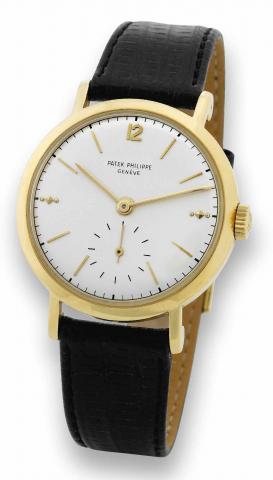
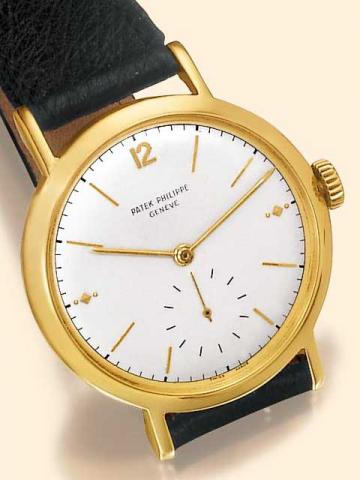
![Patek Philippe. An 18K gold manual wind wristwatch retailed by Trucchi]() Fecha de venta : 22/05/2024País : Reino Unido
Fecha de venta : 22/05/2024País : Reino Unido
Bonhams #29151 - 2024-05 - Watches/WristwatchesLondonID Lote : 69- GBP
- EUR
- USD
Vendido:- 9984
- 11674
- 10855
Categoría : Reloj de pulseraPeríodo : Años 1950Reloj ID : 723784Movimiento : MecánicoCalibre : 12 400 TMateria de la caja de reloj : Oro amarilloForma de la caja de reloj : RedondoDetalle Referencia : 2458Cierre : Hebilla desplegable
Patek Philippe. An 18K gold manual wind wristwatch retailed by Trucchi
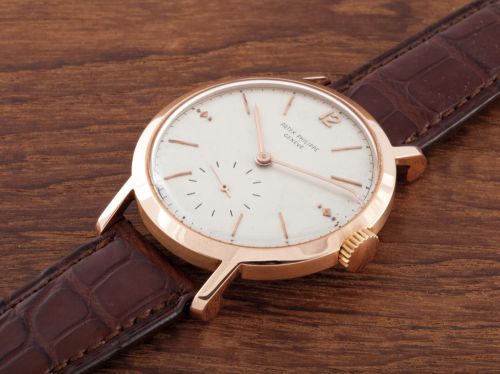
Descripción : Model: Calatrava Reference: 2458 Date: Circa 1950 Movement: Jewelled Cal.12-400 manual wind, No.723784 Dial: Silvered, applied gilt baton hour markers with Arabic numeral 12 and pyramid quarters, subsidiary seconds at 6, gilt pointed baton hands Case: Polished round, snap on back, No.682583 Strap/Bracelet: Associated black leather Buckle/Clasp: Associated steel buckle Signed: Case, dial & movement Size: 37mmVer la descripción de nuestro expertoPatek Philippe. An 18K gold manual wind wristwatch retailed by Trucchi
-
![161.Patek Philippe]() Fecha de venta : 10/05/2015País : Suiza
Fecha de venta : 10/05/2015País : Suiza
Phillips #CH080215 - 2015-05 - The Geneva Watch Auction: OneGenevaID Lote : 161- CHF
- EUR
- USD
Vendido:- 13750
- 11219
- 15720
Estimación:- 10000 - 15000
- 8159 - 12239
- 11433 - 17150
Categoría : Reloj de pulseraMovimiento : MecánicoCalibre : TMateria de la caja de reloj : Oro rosaForma de la caja de reloj : RedondoColor de la esfera : Blanco
161.Patek Philippe
Descripción : 2458, 18k pink gold.1951.36mm. Diameter.Calibre: Manual, 12'''120.Case, dial and movement signedVer la descripción de nuestro experto161.Patek Philippe
-
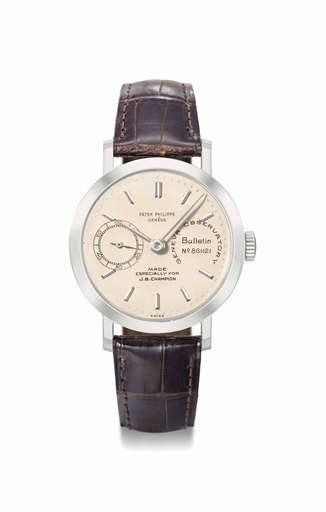
![Patek Philippe. An exceptional, highly attractive, historically important and certainly unique platinum chromometer wristwatch with Guillaume balance, Bulletin d'Observatoire, additional diamond-set dial and platinum bracelet]() Fecha de venta : 12/11/2012País : Suiza
Fecha de venta : 12/11/2012País : Suiza
Christies #1391 - 2012-11 - Important watchesGenevaID Lote : 88- CHF
- EUR
- USD
Vendido:- 3779000
- 4320531
- 3083286
Estimación:- 2000000 - 4000000
- 1631800 - 3263600
- 2286600 - 4573200
Categoría : Reloj de pulseraPeríodo : Siglo dieciochoReloj ID : 861121Movimiento : MecánicoCalibre : 13Materia de la caja de reloj : PlatinoForma de la caja de reloj : RedondoCon diamantes : Sí :Detalle Referencia : 2458Complicaciones : Astronómico, Cronómetro
Patek Philippe. An exceptional, highly attractive, historically important and certainly unique platinum chromometer wristwatch with Guillaume balance, Bulletin d'Observatoire, additional diamond-set dial and platinum bracelet
Descripción : Lot Description.Patek Philippe. An exceptional, highly attractive, historically important and certainly unique platinum chromometer wristwatch with Guillaume balance, Bulletin d'Observatoire, additional diamond-set dial and platinum bracelet.Signed Patek Philippe, Genève, Geneva Observatory Bulletin no. 861121, made especially for J.B Champion, ref. 2458, movement no. 861'121, case no. 673'916, manufactured in 1952.Cal. 13''' Lépine, mechanical movement numbered twice and stamped twice with the Geneva seal, three-quarter plate, 20 jewels, blued steel Breguet balance spring, Guillaume balance, micrometer regulator, silvered matte dial, applied baton numerals, outer beady minute divisions, gold feuille hands, subsidiary seconds, circular heavy case, snap on back, platinum Patek Philippe buckle, case, dial and movement signed.36 mm. diam.__________________________Guillaume__________________________ J.B Champion_____ 2458_1952__ PATEK PHILIPPE. AN EXCEPTIONAL, HIGHLY ATTRACTIVE, HISTORICALLY IMPORTANT AND CERTAINLY UNIQUE PLATINUM CHRONOMETER WRISTWATCH WITH GUILLAUME BALANCE, BULLETIN D’OBSERVATOIRE, ADDITIONAL DIAMOND-SET DIAL AND PLATINUM BRACELET SIGNED PATEK PHILIPPE, GENEVE, GENEVA OBSERVATORY BULLETIN NO. 861121, MADE ESPECIALLY FOR J.B CHAMPION, REF. 2458, MOVEMENT NO. 861’121, CASE NO. 673’916, MANUFACTURED IN 1952 Cal. 13’’’ Lépine, mechanical movement numbered twice and stamped twice with the Geneva seal, three-quarter plate, 20 jewels, blued steel Breguet balance spring, Guillaume balance, micrometer regulator, silvered matte dial, applied baton numerals, outer beady minute divisions, gold feuille hands, subsidiary seconds, circular heavy case, snap on back, platinum Patek Philippe buckle, case, dial and movement signed 36 mm. diam _______________________.Special Notice.Prospective purchasers are advised that several countries prohibit the importation of property containing materials from endangered species, including but not limited to coral, ivory and tortoiseshell. Accordingly, prospective purchasers should familiarize themselves with relevant customs regulations prior to bidding if they intend to import this lot into another country..Pre-Lot Text.Determining the longitudes, chronometry and observatory trials, a brief historical introduction.We thank Arnaud Tellier, horological expert, former director and curator of the Patek Philippe Museum, Geneva..With the invention of the pendulum in the late 1650s, then of the balance spring in 1675, horology could claim the status of an exact science. This considerable progress is due to Christiaan Huygens (1629-1695), Dutch mathematician, astronomer and physicist..In the early eighteenth century, the improvement of the adjusting of timepieces became obvious, nevertheless, it was also true that the search for absolute accuracy was just at its beginning..The precision of clocks and watches is essential since, once embarked on a ship, they can be used to determine the longitude, that is, to finds one's position in the middle of the ocean. The maritime nations of the time - England, Spain, France and the Netherlands - were dismayed by the disasters caused by errors in longitude. For example, the loss of the squadron under the command of Sir Cloudesley Shovell (1650-1707), which shipwrecked on the Isles of Scilly (or Sorlingues) while believing they were in the English Channel (1707), had such a strong impact that years later the British Parliament organized a contest for any method of defining the longitude at sea, offering as incentive 10'000 for a result not exceeding 1 degree of error, 15'000 for 40 minutes and 20'000 for 1/2 degree or less. This was the famous contest of Queen Anne in 1714..In London, the work of Henri Sully (1680-1729), George Graham (1673-1751) and John Harrison (1693-1776) marked the beginning of the eighteenth century. It was in 1735 that Harrison won the contest with his H1 chronometer, but only in 1751 was he able to obtain the first part of the award presented upon the construction of a fourth version. Later on, in 1773, the support offered by King George III (1738-1820) helped him receive the second half of the award for his fifth chronometer. It should also be noted that in 1757, in London, Thomas Mudge (1715-1794) developed the first watch equipped with a lever escapement which since then has been universally used in horology..In France, the watchmakers were equally concerned with the longitude issue. In 1766, Pierre Le Roy (1717-1785) presented in Paris his first chronometer. He built it on entirely new principles that were preserved as the basis of the modern chronometry (detent escapement, isochronous spring, self-compensating balance equipped with adjustable compensation weights, temperature compensation with mercury). He also presented a bi-metallic compensation balance and established the Pierre Le Roy rule stating that for each spring there is a length that makes it isochronous. In 1768, his great rival, Ferdinand Berthoud (1727-1807), completed the first of his marine pieces and also invented a compensation balance. In 1770, Pierre Le Roy was awarded the two prizes offered successively by the Royal Academy of Sciences for the best way of measuring time at sea..In 1772, John Arnold (1736-1799) built in London his first bi-metallic compensation balance based on the principles established by Pierre Le Roy, later on, in 1790, he improved the spring detent escapement. Another British watchmaker, Thomas Earnshaw (1749-1829), developed a marine chronometer so advanced and perfected that its basic principle remained unchanged until the advent of quartz clocks. The rivalry between the two watchmakers was as strong as the one between Le Roy and Berthoud..Chronometry developed in England of the eighteenth century to the point of becoming an industry, while in France it also grew to be an important manufacture under the guidance of Pierre-Louis Berthoud (1754-1813), Ferdinand Berthoud's nephew and disciple, who invented his own pivoted detent escapement..The siècle des Lumières is the time when the marine chronometers were tested in long and perilous journeys. The nineteenth century was when the tests in the astronomical observatories helped verify scientifically several chronometers at once..As early as 1766, the Greenwich Royal Observatory, near London, organized sporadically the first precision contests. In 1823, the British Admiralty created a contest with 300, 200 and 100 Pounds Sterling in prize money, hoping that this way it will acquire for its fleet the best chronometers. Similarly, and at the same time, the French Royal Navy paid 2400 Francs for the award winning chronometers..In 1790, Geneva witnessed the first precision contest among chronometers held at the Society for the Advancement of the Arts. Later on, in 1816, the Astronomical Observatory of Geneva hosted the creation of a trial, which subsequently was conducted only occasionally. It was not until 1879 that this type of contest became an institution. The precision level of the watches is evaluated through a points system set at that time by Emile Plantamour (1815-1882), Director of the Observatory. This system with prizes (1st, 2nd and 3rd prize, then honorable mention or without) and different classes (marine chronometer, deck or pocket, with or without special features), was shortly after joined in 1884 by the Astronomical Observatory of Kew and Teddington in Great Britain and, in 1885, by that of the Astronomical Observatory of Besançon, in France. The contests organized by the Neuchâtel, Hamburg and Washington observatories also enjoyed greatest consideration. Unfortunately, it hasn't been possible to standardize the tests between the different countries, so today it is impossible to compare their results. In addition to publishing the rankings in the official publications, the award winning time-pieces also received an official certificate of accuracy and a gold, silver or bronze medal..Patek Philippe and the Timing Competitions.Patek Philippe watches participated with remarkable success at many of the trials which soon became very important events, nationally and internationally. In 1884 and 1895, the Geneva manufacturer managed to also win the prestigious series prize for the five most precise pocket watches. Between 1900 and 1939 - the year when the firm celebrated its centennial - it won 764 prizes in Geneva, of which 187 were first prizes, this represents more than half of the prizes awarded during that time..Between 1943 and 1966, Patek Philippe presented 480 times to the Geneva Astronomical Observatory movements (simple, with no complications) from the D category (format not exceeding 30 mm in diameter or 706.86 mm2) and 27 times movements with a tourbillion regulator. As these movements could be presented on several occasions over the years, it would be difficult to determine the exact number of manufactured wristwatch chronometer movements. Moreover, many of them would never be sold and are currently preserved in the vaults of the manufacturer and the company's own museum..Patek Philippe did also compete in contests abroad. This is particularly the case during the 1960s when the manufacturer received the highest British distinction, the Craftsmanship Test, introduced in 1951. Only twelve watches can claim to have won it, amongst them the Patek Philippe pocket watch with tourbillon, No 198'423, having furthermore achieved the best results ever. The Observatory of Geneva tests were interrupted in 1967, with the arrival of quartz watches..The COSC.Today only COSC (Contrôle Officiel Suisse de Chronométrie the Official Swiss Chronometer Testing Institute) performs accuracy testing and issues certificates. A law dated November 6th, 1886 on testing the accuracy of the pocket watches at the Geneva Observatory, set the conditions, certified through an official engraved hallmark, where the Geneva quality is applied to certain watches. This stamp has the same value as an official accuracy certificate and allows qualifying the watch as a chronometer. After several amendments and additions in 1891, 1931 and 1955, made necessary by the technical progress, the regulation on testing of the mechanical watches received its final form on April 5th, 1957..View.Lot Notes ›Ver la descripción de nuestro expertoPatek Philippe. An exceptional, highly attractive, historically important and certainly unique platinum chromometer wristwatch with Guillaume balance, Bulletin d'Observatoire, additional diamond-set dial and platinum bracelet
-
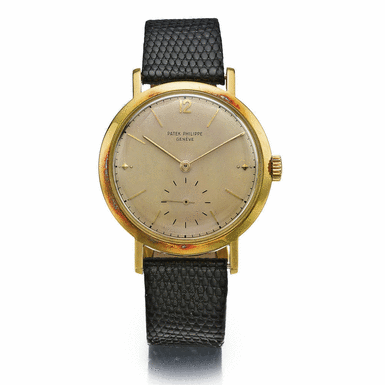
![PATEK PHILIPPE - A RARE AND LARGE 18K YELLOW GOLD WRISTWATCH 1950 REF 2458 MVT 965930 CASE 657003]() Fecha de venta : 06/12/2011País : Estados Unidos
Fecha de venta : 06/12/2011País : Estados Unidos
Sothebys #N08772 - 2011-12 - Important Watches & ClocksNew YorkID Lote : 353- USD
- EUR
- USD
Vendido:- 15625
- 11144
- 15625
Estimación:- 5000 - 7000
- 3566 - 4992
- 5000 - 7000
Categoría : Reloj de pulseraMateria de la caja de reloj : Oro amarilloDetalle Referencia : 2458
PATEK PHILIPPE - A RARE AND LARGE 18K YELLOW GOLD WRISTWATCH 1950 REF 2458 MVT 965930 CASE 657003
Descripción : A very nice example. The movement is running at the time of cataloguing, however it may require service soon. The dial.The case is very nicely preserved, with a strong 18K mark to the outside of the back and good definition to the lugs. There are some surface scuffs throughout.Ver la descripción de nuestro expertoPATEK PHILIPPE - A RARE AND LARGE 18K YELLOW GOLD WRISTWATCH 1950 REF 2458 MVT 965930 CASE 657003
-
![Patek Philippe, Ref. 2458 Yellow Gold.Patek Philippe, Gen]() Fecha de venta : 09/10/2010País : RAE de Hong Kong (China)
Fecha de venta : 09/10/2010País : RAE de Hong Kong (China)
Antiquorum #241 - 2010-10 - Important Modern & Vintage TimepiecesHong KongID Lote : 282- HKD
- EUR
- USD
Vendido:- 150000
- 13770
- 19305
Estimación:- 80000 - 120000
- 7344 - 11016
- 10296 - 15444
Categoría : Reloj de pulseraPeríodo : Años 1950Calibre : 12 120Materia de la caja de reloj : Oro amarilloForma de la caja de reloj : RedondoColor de la esfera : PlateadoDetalle Referencia : 2458Grosor : 9 mm
Patek Philippe, Ref. 2458 Yellow Gold.Patek Philippe, Gen
Descripción : C. Two-body, solid, polished and brushed, straight curved.lugs, snap-on case back..D. Matte silver with applied yellow gold baton, pyramid and.round indexes and Arabic 12, subsidiary seconds dial, outer.minute track. Yellow gold baton hands..M. Cal. 12 '''120, rhodium-plated, fausses cotes decoration.18 jewels, straight-line lever escapement, monometallic.balance, self-compensating Breguet balance spring.swan-neck regulator..Dial, case and movement signed..Diam. 36 mm. Thickness 9 mm.Ver la descripción de nuestro expertoPatek Philippe, Ref. 2458 Yellow Gold.Patek Philippe, Gen
-
![Ref. 2458 Yellow Gold.Patek Philippe & Cie, Gen]() Fecha de venta : 17/09/2009País : Estados Unidos
Fecha de venta : 17/09/2009País : Estados Unidos
Antiquorum #219 - 2009-09 - Important Collector's Wristwatches, Pocket Watches & ClocksSession 1New YorkID Lote : 124- USD
- EUR
- USD
Vendido:- 10200
- 7275
- 10200
Estimación:- 7500 - 9500
- 5349 - 6775
- 7500 - 9500
Categoría : Reloj de pulseraPeríodo : Años 1950Reloj ID : 969936Calibre : 12 400Materia de la caja de reloj : Oro amarilloForma de la caja de reloj : RedondoColor de la esfera : PlateadoDetalle Referencia : 2458Grosor : 9 mm
Ref. 2458 Yellow Gold.Patek Philippe & Cie, Gen
Descripción : C. Two-body, solid, polished, straight lugs. D. Matte silver with.applied yellow gold baton, pyramid and round indexes and.Arabic 12, subsidiary seconds dial. Yellow gold baton hands..M. Cal. 12 '''-400, rhodium-plated, fausses cotes decoration, 18.jewels, straight-line lever escapement, monometallic balance.adjusted for heat, cold, isochronism and 5 positions, shock.absorber, self-compensating Breguet balance spring, swanneck.micrometer regulator..Dial, case and movement signed..Diam. 36 mm. Thickness 9 mm.Ver la descripción de nuestro expertoRef. 2458 Yellow Gold.Patek Philippe & Cie, Gen
-
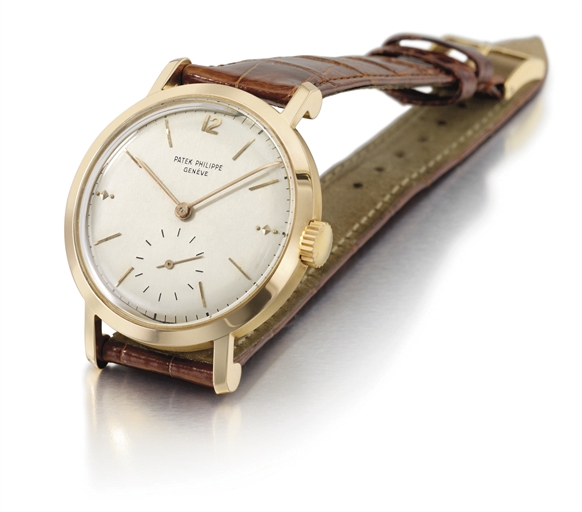
![Patek Philippe. A fine and large 18K pink gold wristwatch with unusual lugs]() Fecha de venta : 11/05/2009País : Suiza
Fecha de venta : 11/05/2009País : Suiza
Christies #1366 - 2009-05 - Important watchesGenevaID Lote : 248- CHF
- EUR
- USD
Vendido:- 21250
- 17338
- 24295
Estimación:- 15000 - 25000
- 12239 - 20398
- 17150 - 28583
Categoría : Reloj de pulseraPeríodo : Años 1950Reloj ID : 664559 MANUFACTURED 1951Calibre : 12120Materia de la caja de reloj : Oro rosaForma de la caja de reloj : CuadradoDetalle Referencia : 2458
Patek Philippe. A fine and large 18K pink gold wristwatch with unusual lugs
Descripción : Lot Description.Patek Philippe. A fine and large 18K pink gold wristwatch with unusual lugs.Signed Patek Philippe, Geneve, ref. 2458, movement no. 969'359, case no. 664'559, manufactured in 1951.Cal. 12'''120 nickel-finished lever movement, 18 jewels, bimetallic compensation balance, swan-neck regulator, silvered dial, applied gold baton, square-shaped and Arabic numerals, subsidiary seconds, circular case, enlarged bezel, snap on back, 18K gold Patek Philippe buckle, case, dial and movement signed.37 mm. diam..Special Notice.Prospective purchasers are advised that several countries prohibit the importation of property containing materials from endangered species, including but not limited to coral, ivory and tortoiseshell. Accordingly, prospective purchasers should familiarize themselves with relevant customs regulations prior to bidding if they intend to import this lot into another country..View Lot Notes ›Ver la descripción de nuestro expertoPatek Philippe. A fine and large 18K pink gold wristwatch with unusual lugs
-
![Patek Philippe. A fine, large and rare 18K pink gold wristwatch with unusual lugs]() Fecha de venta : 17/11/2008País : Suiza
Fecha de venta : 17/11/2008País : Suiza
Christies #1357 - 2008-11 - Important watchesGenevaID Lote : 266- CHF
- EUR
- USD
Vendido:- 23750
- 19378
- 27153
Estimación:- 20000 - 30000
- 16318 - 24477
- 22866 - 34299
Categoría : Reloj de pulseraPeríodo : Años 1950Reloj ID : 664559 MANUFACTURED 1951Calibre : 12120Materia de la caja de reloj : Oro rosaForma de la caja de reloj : RedondoDetalle Referencia : 2458
Patek Philippe. A fine, large and rare 18K pink gold wristwatch with unusual lugs
Descripción : Lot Description.Patek Philippe. A fine, large and rare 18K pink gold wristwatch with unusual lugs.Signed Patek Philippe, Genève, ref. 2458, movement no. 969'359, case no. 664'559, manufactured in 1951.Cal. 12'''120 nickel-finished lever movement, 18 jewels, bimetallic compensation balance, swan-neck regulator, silvered dial, applied gold baton, square-shaped and Arabic numerals, circular case, enlarged bezel, snap on back, 18K gold Patek Philippe buckle, case, dial and movement signed.37 mm. diam.View Lot Notes ›Ver la descripción de nuestro expertoPatek Philippe. A fine, large and rare 18K pink gold wristwatch with unusual lugs
-
![PATEK PHILIPPE - A RARE LARGE GOLD WRISTWATCH 1951 REF 2458J MVT 969455 CASE 667780]() Fecha de venta : 23/04/2008País : Estados Unidos
Fecha de venta : 23/04/2008País : Estados Unidos
Sothebys #N08433 - 2008-04 - Important WatchesNew YorkID Lote : 206- EUR
- EUR
- USD
Sin vender- ...
- ...
- ...
Estimación:- 9000 - 11000
- 6419 - 7845
- 9000 - 11000
Categoría : Reloj de pulseraMateria de la caja de reloj : Oro amarilloDetalle Referencia : 2458J
PATEK PHILIPPE - A RARE LARGE GOLD WRISTWATCH 1951 REF 2458J MVT 969455 CASE 667780
Ver la descripción de nuestro expertoPATEK PHILIPPE - A RARE LARGE GOLD WRISTWATCH 1951 REF 2458J MVT 969455 CASE 667780
-
![Patek Philippe & Cie, Gen]() Fecha de venta : 16/11/2002País : Suiza
Fecha de venta : 16/11/2002País : Suiza
Antiquorum #32 - 2002-11 - Thematic Auction in Geneva:The Evolution of Forms in HorologyGenevaID Lote : 571- CHF
- EUR
- USD
Vendido:- 6325
- 5161
- 7231
Estimación:- 11000 - 13000
- 8975 - 10607
- 12576 - 14863
Categoría : Reloj de pulseraReloj ID : 721 355Calibre : 12 400 STAMPED GENEVA QUALITY HALLMARKMateria de la caja de reloj : Oro amarilloColor de la esfera : PlateadoDetalle Referencia : 2458 . PRO DUCTION
Patek Philippe & Cie, Gen
Descripción : C. two-body, solid, polished, straight lugs. D. matte silver with applied yellow gold bâton, pyramidal and baton indexes and Arabic numerals, auxiliary seconds dial. Bâton yellow gold hands. M. Cal. 12 '''-400, stamped with the Geneva Quality Hallmark, rhodium-plated, fausses-côtes decoration, 18 je-wels, straight line lever escapement, monometallic balance ad-justed for heat, cold, isochronism and 5 positions, shock-ab-sorber, micrometer regulator, self-compensating Breguet balance-spring.Dial, case and movement signed.Diam. 36 mm.Ver la descripción de nuestro expertoPatek Philippe & Cie, Gen




Para descubrir en Collector Square
Para descubrir en Collector Square
¿Usted quiere una estimación?
Hacer una solicitud de peritaje-
![Rolex Daytona]()
Rolex Daytona
Su precio promedio ha sido multiplicado por 2 en 12 años
-
![Rolex GMT-Master]()
Rolex GMT-Master
Su precio promedio ha sido multiplicado por 10 entre 2003 y 2016
-
![Rolex]()
Rolex
La segunda marca relojera la más vendida en las subastas